
Explore Claude Haiku 4.5 from Anthropic: smarter AI agents with superior coding and reasoning at a fraction of the cost.
Introducing Claude Haiku 4.5: The Fast, Affordable AI Leap
In October 2025, Anthropic unveiled Claude Haiku 4.5, a new lightweight AI model that bridges the gap between cost and performance. While not a “frontier” model, Haiku 4.5 delivers near-frontier level coding and reasoning power — at one-third the cost and over twice the speed of its flagship counterparts.
This launch signals a shift: advanced AI won’t just be for deep pockets — now, more developers, startups, and applications can tap high capability without huge compute bills.
What Is Claude Haiku 4.5?
Positioning in the Claude Model Family
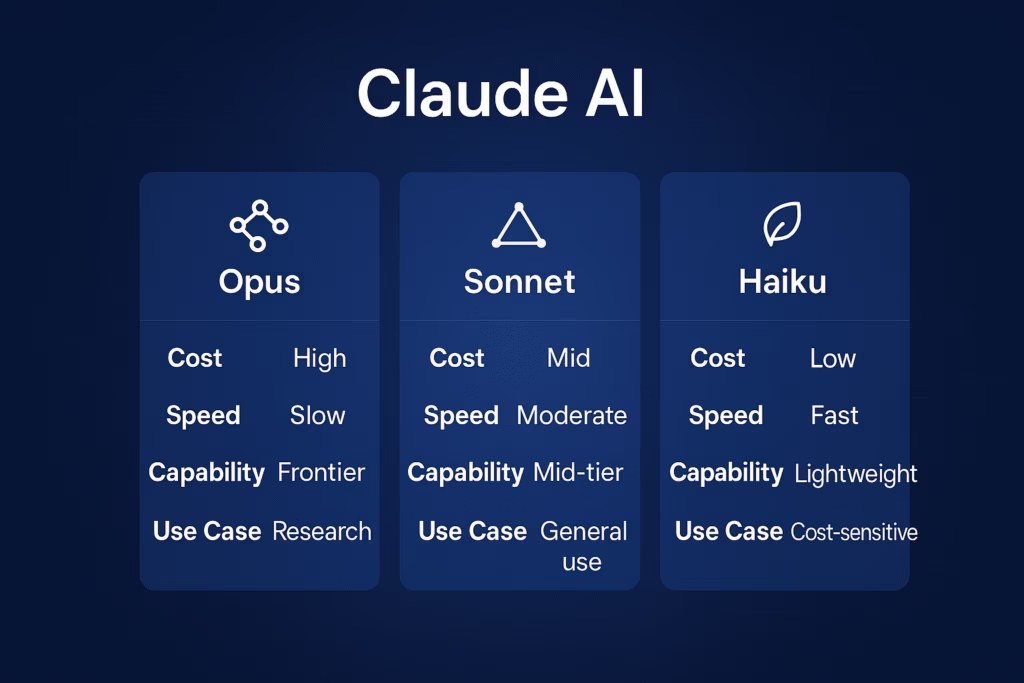
Claude 4’s lineup includes Opus (frontier), Sonnet (mid-tier), and now Haiku as the lightweight but powerful model. Haiku 4.5 slots below Sonnet 4.5 but is capable enough for many demanding tasks.
Pricing & Availability
- The cost is set at $1 per million input tokens and $5 per million output tokens.
- It’s available via Claude API and is also integrated into Amazon Bedrock globally.
- Additionally, Haiku 4.5 is rolling out in GitHub Copilot (for Pro, Business, Enterprise users).
Key Improvements Over Haiku 3.5 & Sonnet 4
Performance & Benchmarks
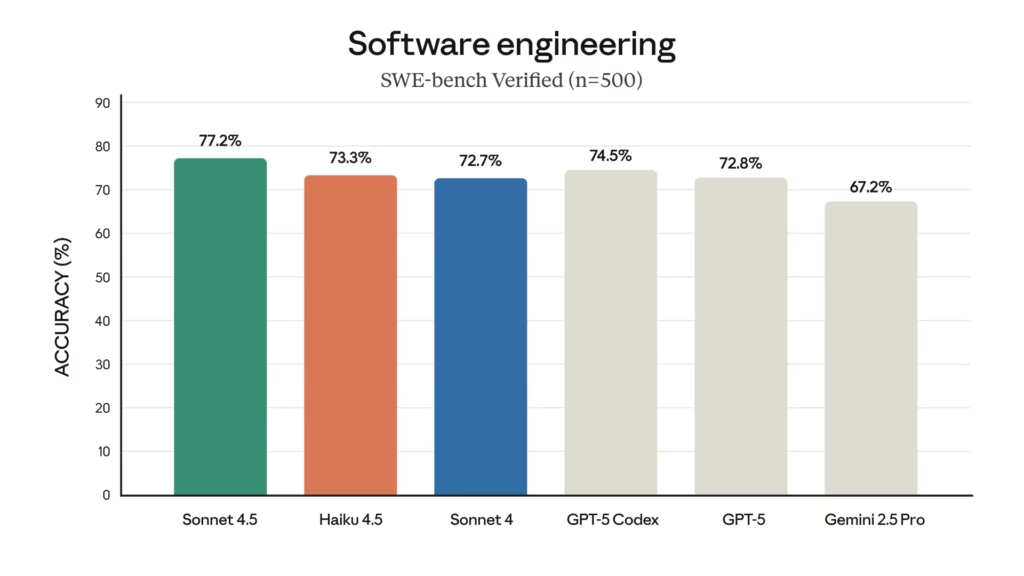
On SWE-bench Verified (a coding benchmark), Haiku 4.5 scored 73.3%, slightly surpassing Sonnet 4’s score of ~72.7%.
In other tasks like computer use / agentic coding, Haiku 4.5 even outperforms Sonnet 4 in some cases.
Speed & Latency Gains
Haiku 4.5 is over twice as fast as Sonnet 4.
This speed boost is crucial for latency-sensitive uses: chat agents, real-time assistants, or interactive coding tools.
Safety & Alignment Enhancements
According to its system card, Haiku 4.5 demonstrates substantially better alignment than Haiku 3.5, and in many metrics, compares favorably even with Opus 4.1 and Sonnet 4.5.
That said, Anthropic notes some minor exceptions in edge-case behaviors. Performance & Benchmarks
On SWE-bench Verified (a coding benchmark), Haiku 4.5 scored 73.3%, slightly surpassing Sonnet 4’s score of ~72.7%.
In other tasks like computer use / agentic coding, Haiku 4.5 even outperforms Sonnet 4 in some cases.
Speed & Latency Gains
Haiku 4.5 is over twice as fast as Sonnet 4.
This speed boost is crucial for latency-sensitive uses: chat agents, real-time assistants, or interactive coding tools.
Safety & Alignment Enhancements
According to its system card, Haiku 4.5 demonstrates substantially better alignment than Haiku 3.5, and in many metrics, compares favorably even with Opus 4.1 and Sonnet 4.5.
That said, Anthropic notes some minor exceptions in edge-case behaviors.
Use Cases & Real-World Applications
Code Generation & Agentic Coding
Haiku 4.5 shines in coding tasks. It’s aimed at use cases where speed matters, such as pair programming, inline code suggestions, and automated refactors.
Multi-Agent Orchestration (Sonnet + Haiku)
One powerful pattern: use Sonnet 4.5 (or the flagship model) to plan and break down a complex problem, then spawn multiple Haiku 4.5 agents to execute subtasks in parallel. This hybrid architecture unlocks scale at lower cost.
Real-Time Chat, Assistants & Latency-Sensitive Tasks
For real-time agents, chatbots, or UIs needing instant AI responses, Haiku 4.5 offers the sweet spot. Its responsiveness makes user experience smoother.
Integration & Ecosystem Support
Availability on Claude API & Amazon Bedrock
You can call Haiku 4.5 via claude-haiku-4-5 on the Claude API interface.In Amazon Bedrock, Haiku 4.5 is now globally available with cross-region inference.
Support in GitHub Copilot
Haiku 4.5 is now in public preview for GitHub Copilot. Users will be able to select Haiku 4.5 in model picker in VS Code, GitHub UI, and mobile apps.
Developer Adoption & Community Reactions
Early adopters report that Haiku 4.5 “hit a sweet spot” — near-frontier coding quality with speed and cost efficiency.
On forums like Reddit, users note that Haiku 4.5 is intended as a “drop-in replacement” for older Haiku or Sonnet versions.
Trade-offs & Things to Watch
Where Haiku 4.5 Isn’t Optimal
Haiku 4.5 is not designed to replace frontier models entirely. In deep, multi-step reasoning, extremely long context workflows, or very complex agent orchestration, Sonnet or Opus may still outperform.
Edge Cases & Safety Caveats
While safety metrics improved, the system card notes minor exceptions remain. Users should be cautious about adversarial or tricky prompts.
Future Outlook & Implications for AI Ecosystem
Haiku 4.5’s arrival pushes a new paradigm: high capability, low cost. This could democratize AI for many more developers, startups, and business use cases.
We are likely to see:
- More hybrid model architectures, combining strong planning models + faster submodels
- Proliferation of agent frameworks orchestrating many small models
- Increased competition on cost efficiency across AI providers
- A shift in how AI systems are built — moving away from monolithic one-size models
Conclusion
Claude Haiku 4.5 is a strategic and technical milestone for Anthropic. It brings near-frontier performance into a lighter, faster, more accessible package. For many users, it may well become the go-to model for coding, agents, and responsive tools.