
The AI revolution isn’t coming—it’s already here. Discover the trends reshaping how we work, create, and innovate in 2026.
Remember when AI was just about chatbots answering simple questions? Those days are gone. In 2026, artificial intelligence has evolved into something far more powerful and practical. It’s not replacing humans—it’s amplifying what we can achieve.
If you’re trying to understand where AI is headed and how it affects you, this guide breaks down the most important trends without the hype or technical jargon.
AI Agents: Your New Digital Teammates
The biggest shift in 2026 isn’t about smarter AI—it’s about AI that actually does things. Welcome to the era of AI agents.
Think of AI agents as digital colleagues who can handle complete projects from start to finish. Unlike traditional AI tools that wait for your instructions, agents can plan, make decisions, and adapt when things change. They’re not just answering questions anymore; they’re booking meetings, writing code, managing customer inquiries, and coordinating entire workflows.
The numbers tell an impressive story. By the end of 2026, 40% of business applications will have AI agents built in, compared to less than 5% just last year. Nearly 80% of workplace tools now feature AI copilots working alongside humans.
What does this mean for you? If you work in customer service, development, marketing, or operations, you’ve likely already encountered these agents. They’re handling the repetitive tasks that used to consume hours of your day, freeing you to focus on strategy, creativity, and human connection.
From Personal Productivity to Team Power
Here’s what’s changed: AI isn’t just making individuals more productive anymore. It’s transforming how entire teams collaborate.
Organizations are moving beyond isolated AI tools to create connected ecosystems where AI coordinates work across departments. Instead of using separate agents for email, scheduling, data analysis, and project management, companies are building unified systems that handle everything seamlessly.
This shift matters because AI’s real value emerges when it connects information across your organization. An AI agent that can access your customer data, marketing campaigns, and sales pipeline simultaneously delivers insights no single-purpose tool could provide.
The key difference? We’ve moved from asking “Can AI do this task?” to “How can AI improve our entire workflow?” That’s the transformation happening in 2026.
AI That Sees, Hears, and Understands Everything
Multimodal AI represents one of 2026’s most exciting developments. These systems process images, text, audio, and video simultaneously—just like humans do.
In healthcare, multimodal AI analyzes medical images alongside patient records and symptoms to assist with diagnoses. In education, it adapts to whether you learn better through reading, watching videos, or interactive exercises. Autonomous vehicles process camera feeds, radar data, and sensor information together to navigate safely.
Why does this matter? Because real-world problems rarely fit into a single category. When AI can understand context from multiple sources, it becomes genuinely helpful rather than just impressive.
Imagine showing an AI agent a photo of your refrigerator’s contents and asking for dinner recipes based on dietary restrictions mentioned in your previous conversations. That’s multimodal AI in action—and it’s happening now.
The Open-Source Revolution
2026 has witnessed a dramatic shift in who can build and access cutting-edge AI. Open-source models are challenging the assumption that only tech giants with billion-dollar budgets can create powerful AI.
DeepSeek’s release of R1, a sophisticated reasoning model built with relatively limited resources, demonstrated that innovation doesn’t require massive infrastructure. This has inspired a wave of accessible, specialized AI models that smaller organizations can customize for their specific needs.
The practical impact? Businesses no longer need to choose between expensive proprietary systems and building everything from scratch. They can start with proven open-source models and fine-tune them for their industry, whether that’s legal analysis, medical diagnosis, or financial forecasting.
For developers and tech-savvy professionals, this democratization means you can experiment with state-of-the-art AI without enterprise budgets. For businesses, it means competitive AI capabilities are finally accessible regardless of company size.
AI as a Scientific Partner
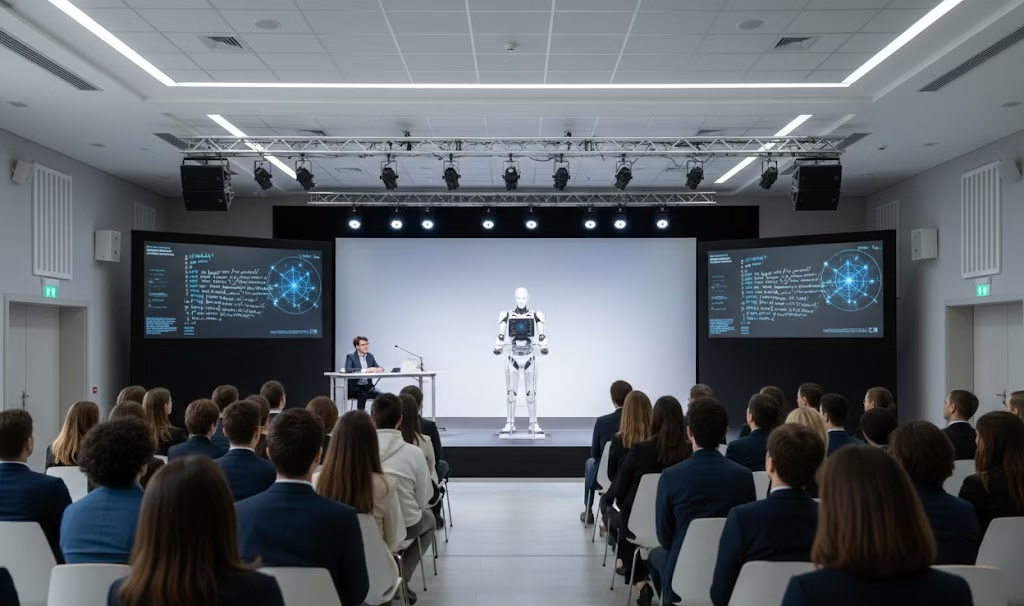
Perhaps the most profound trend is AI’s evolution into a genuine research collaborator. Scientists aren’t just using AI to analyze data anymore—they’re partnering with AI to generate hypotheses, design experiments, and discover breakthroughs.
In climate science, AI systems model complex environmental interactions at unprecedented scales. In drug discovery, AI suggests molecular structures that human researchers might never consider. Across physics, chemistry, and biology, AI lab assistants accelerate the pace of discovery.
This matters beyond academia. Faster scientific breakthroughs mean quicker solutions to climate change, new medical treatments, innovative materials, and technological advances that improve daily life.
Security Isn’t Optional Anymore
As AI agents gain autonomy, security has evolved from an afterthought to a fundamental requirement. Organizations are implementing “AI identity management”—treating AI agents with the same security protocols as human employees.
This includes limiting which systems agents can access, monitoring their activities for unusual behavior, requiring human approval for high-stakes decisions, and protecting them from manipulation or attacks.
Why should you care? Because as AI handles more critical tasks, a security breach could mean leaked customer data, financial losses, or compromised operations. Companies that build security into their AI systems from day one—rather than adding it later—gain both protection and competitive advantage.
Three-quarters of organizations now prioritize security and compliance as their top requirement for AI deployment. This isn’t just corporate responsibility; it’s business survival.
Anyone Can Build AI Now
The most democratizing trend in 2026 is the rise of no-code and low-code AI platforms. You no longer need a computer science degree to create intelligent applications.
HR professionals build chatbots for employee questions. Marketing teams create automated campaign analyzers. Finance departments deploy forecasting tools. All without writing complex code—just describing what they want in plain language.
Building a basic AI agent now takes 15 to 60 minutes on most platforms. Roughly 40% of enterprise software is being built through natural language prompts rather than traditional programming.
This shift means the best AI solutions often come from people who deeply understand the problem—not necessarily from technical experts. A nurse might design a better patient scheduling system than a software engineer because they understand the workflow intimately.
What This Means for You
Whether you’re a business leader, employee, or simply AI-curious, these trends create both opportunities and imperatives.
For business leaders: AI is no longer a “nice to have.” Your competitors are using it to operate faster, serve customers better, and innovate more quickly. The question isn’t whether to adopt AI, but how quickly you can implement it strategically. Focus on enterprise-wide deployment rather than isolated experiments, and invest in the data foundations that make AI effective.
For professionals: AI won’t replace you, but someone using AI might. Develop AI literacy—understand how to work alongside these tools. Focus on skills AI can’t replicate: strategic thinking, creativity, empathy, and relationship building. Learn to design workflows that leverage AI’s strengths while contributing your uniquely human capabilities.
For everyone: AI is becoming as fundamental as smartphones or the internet. Understanding its capabilities and limitations helps you use it effectively and recognize when you’re interacting with it. Stay informed, experiment responsibly, and think critically about how AI should fit into your life and work.
The Challenges We’re Navigating
Despite the excitement, 2026’s AI landscape includes real challenges. Integration with existing systems remains complex—46% of organizations cite this as their top obstacle. Data quality and access issues affect 42% of implementations. Change management—helping teams adapt to new AI-powered workflows—challenges 39% of companies.
Nine in ten business leaders report that AI agents are fundamentally changing how their teams work. Employees spend more time on strategic activities and less on routine execution. This shift is positive, but it requires training, patience, and cultural adaptation.
The regulatory landscape remains uncertain, with ongoing debates about who governs AI and how. Privacy concerns, ethical considerations, and the need for transparency continue to shape how organizations deploy these technologies.
Looking Forward: What’s Next?
The trajectory is clear: AI will become more capable, more accessible, and more integrated into daily life and work. But the future isn’t about AI replacing humans—it’s about collaboration.
Think of AI as a tireless assistant with perfect memory and instant access to information, paired with your creativity, judgment, and emotional intelligence. Together, this combination achieves more than either could alone.
The organizations thriving in 2026 share common traits. They act decisively rather than waiting for “perfect” AI solutions. They build strong data foundations that make AI effective. They invest in helping their workforce adapt. And most importantly, they focus on measurable outcomes rather than technological experimentation for its own sake.
Your Next Steps
Understanding AI trends matters only if you act on them. Start small but start now. Experiment with AI tools in your daily work. Identify repetitive tasks where AI could help. Learn from failures—they’re cheaper now than waiting until competitors force your hand.
If you’re leading a team or organization, begin with a clear use case where AI can deliver measurable value. Build proof of impact, not just proof of concept. Prioritize security and data quality from the beginning, not as afterthoughts.
For individuals, develop a learning mindset. Take online courses, experiment with accessible AI tools, and stay curious about developments. The AI-powered future belongs to those who adapt and evolve alongside these technologies.

The Bottom Line
AI in 2026 isn’t science fiction—it’s practical technology solving real problems. From autonomous agents handling complex workflows to accessible tools anyone can use, AI is reshaping every industry and profession.
The winners won’t necessarily be those with the biggest AI budgets or the most advanced technology. They’ll be the people and organizations that understand how to combine AI’s capabilities with human creativity, empathy, and strategic thinking.
The future is here. The question is: are you ready to be part of it?
Key Takeaways
- AI agents are autonomously handling complete workflows, not just individual tasks
- Team orchestration has replaced individual productivity as AI’s primary value
- Multimodal AI processes multiple data types simultaneously for better understanding
- Open-source models are democratizing access to cutting-edge AI
- Scientific collaboration with AI is accelerating breakthrough discoveries
- Security-first approaches are now mandatory, not optional
- No-code platforms let anyone build AI solutions without programming skills